
fencing 101: a guidebook for new parents
The Top 10 Things Every New Fencing Parent Should Know about fencing
Getting to Know the Olympic Sport of Fencing
Fencing is one of the world’s oldest and coolest sports—once practiced by kings, nobles, and master swordsmen who trained for duels fought to first blood. Long before it became an Olympic sport, fencing was how warriors sharpened their reflexes, strategy, and nerve. Today, that same tradition lives on in a fast, safe, and exciting modern sport that blends athleticism with high-level thinking. Fencing has been part of the Olympic Games since the very first modern Olympics, is competed at high school varsity and NCAA levels, and is practiced by athletes around the globe.
Here is a top-10 list of things to help you get started learning about the sport and what you need to participate in it!
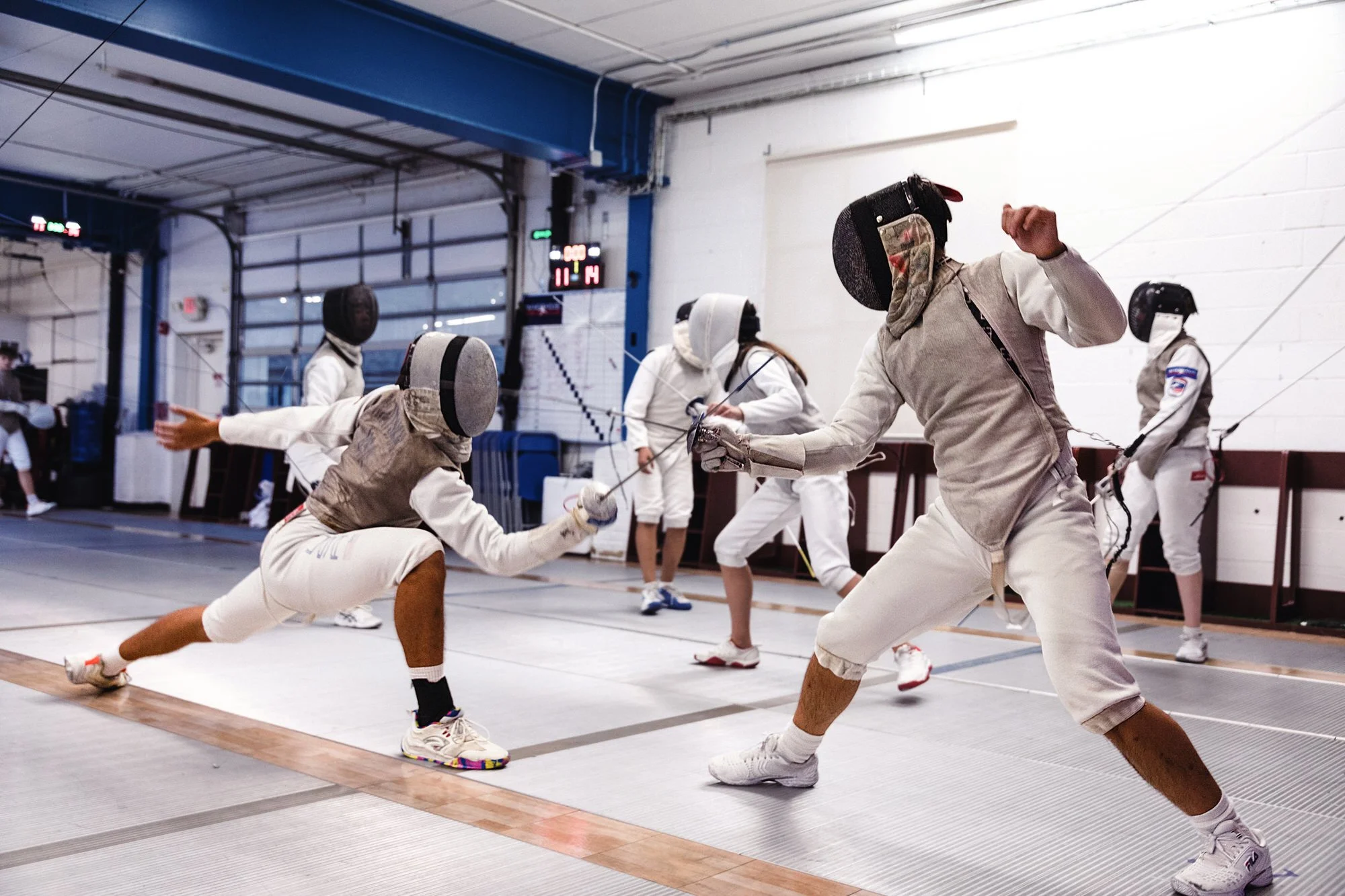
1.The Objective of Fencing
The goal of fencing is simple: score more touches than your opponent.
Fencing uses an electronic scoring system that makes the sport fast, fair, and easy to follow once you know what to watch for. Each fencer’s weapon is connected by a cord to a scoring box, and when a valid touch is made, colored lights illuminate to show who scored. The rules for what counts as a valid touch depend on the weapon (foil, épée, or sabre), but the system ensures points are registered instantly—no guesswork or excessive force required. Bouts are typically fenced to a set number of touches (often 5 or 15), with a time limit, and fencers score by landing clean, controlled touches on valid target areas. The result is a sport that rewards precision, timing, and decision-making, not strength—making every point feel quick, exciting, and intentional.
In pool bouts, fencers compete to five touches
In direct elimination bouts, fencers compete to 15 touches or until time expires
Each time a fencer scores a valid touch, they earn one point
Bouts are fenced on a long strip called a piste, and matches are divided into timed periods depending on the weapon and bout format.
Fencing uses an electronic scoring system that makes the sport fast, fair, and easy to follow once you know what to watch for. Each fencer’s weapon is connected by a cord to a scoring box, and when a valid touch is made, colored lights illuminate to show who scored. The rules for what counts as a valid touch depend on the weapon (foil, épée, or sabre), but the system ensures points are registered instantly—no guesswork or excessive force required. Bouts are typically fenced to a set number of touches (often 5 or 15), with a time limit, and fencers score by landing clean, controlled touches on valid target areas. The result is a sport that rewards precision, timing, and decision-making, not strength—making every point feel quick, exciting, and intentional.
2. Fencing Fast Facts
Fencing is one of just five sports contested at every Olympics since 1896. (The others are athletics, cycling, swimming and gymnastics.)
The metal fencing strip, or piste, is about 46 feet long. That's about a foot shorter than the distance from the baseline to the half-court line on a basketball court.
Action begins when the referee says "En garde! Prêts? Allez!" — or "On guard! Ready? Fence!"
Most fencing tournaments begin with round-robin pool play (first to five touches) followed by elimination rounds (first to 15 touches).
3. Fencing Is One of the Safest Sports
Despite how it may look, fencing is extremely safe.
All weapons are blunted and designed for sport
Athletes wear protective jackets, masks, gloves, and underarm protectors
Safety rules are strict and enforced consistently
Injury rates in fencing are lower than many common youth sports.
4.Fencing Is for Everyone! (And A lot of fun!)
Fencing welcomes athletes of:
Different body types
Different personalities
Different athletic backgrounds
There are competitive categories that run from Youth-8 all the way to 80+!
There is room in fencing for thinkers, competitors, leaders, and creatives alike—and many pathways for success.
5. Benefits & Opportunities in Fencing — Quick Checklist
Why families choose fencing:
✅ Pathway to College Recruitment
Fencing is one of the top sports in the country for college recruitment
✅ Competition for All Ages & Levels
Youth (Y10, Y12) through Cadet, Junior, Senior, and Veterans (40+, 50+, 60+)
✅ Develops Critical Thinking
Strategy, problem-solving, and decision-making under pressure
✅ Builds Athletic Skills
Excellent hand-eye coordination, balance, agility, and motor skills
✅ Individual Progress, No Bench
Athletes advance at their own pace with opportunities to fence at every level
✅ Team Environment in Practice
Strong club culture where athletes train and improve together
✅ Supports Academic Success
Rewards focus, discipline, and long-term commitment
✅ Lifelong Sport
A sport athletes can enjoy and compete in for decades
6. There Are Three Weapons: Foil, Épée, and SabER
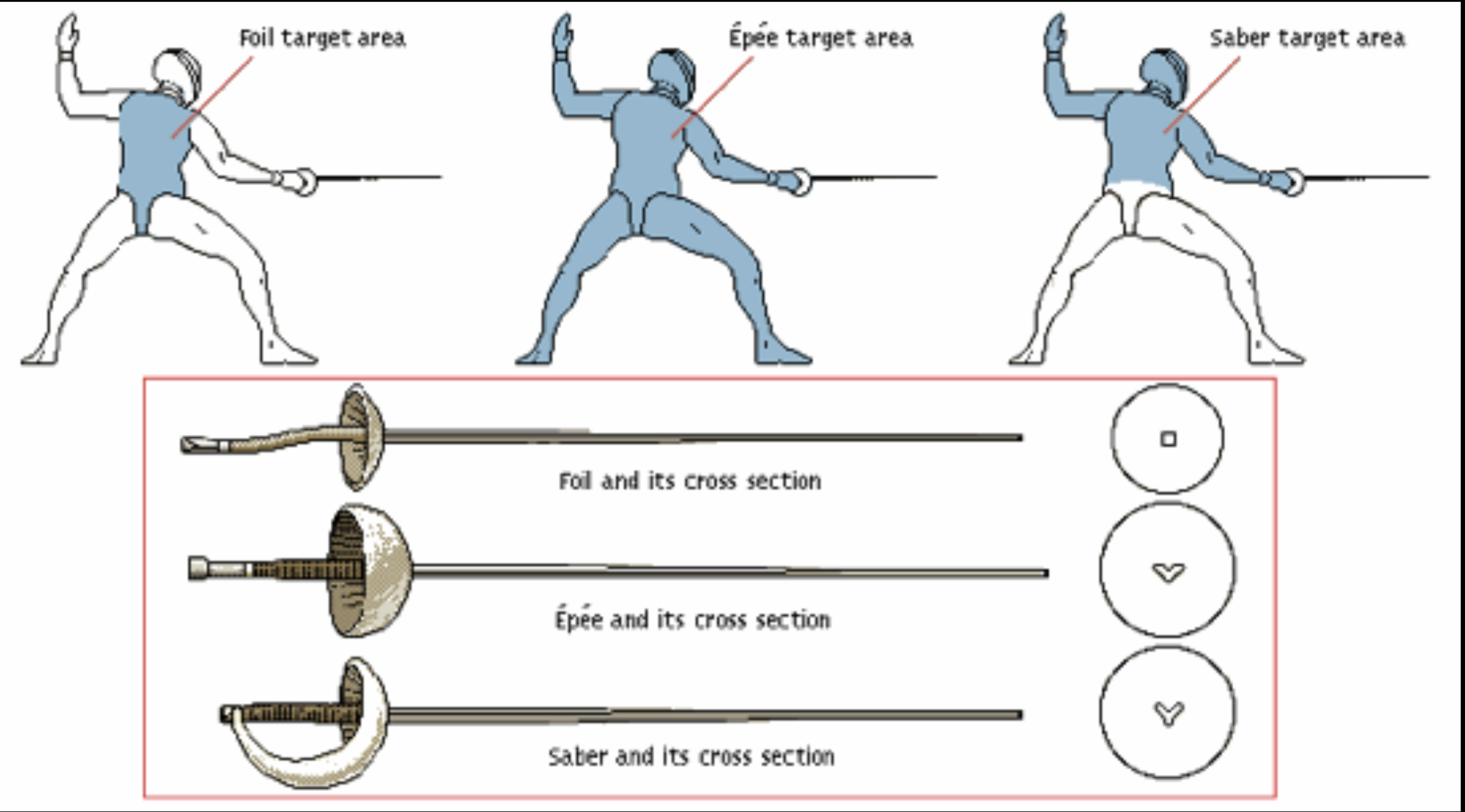
Fencing has three distinct disciplines, each with different rules and strategies:
Foil – A precision-based weapon where touches score only on the torso
Épée – The entire body is a valid target; patience and timing matter
Sabre – Fast and explosive; touches score above the waist and include cutting actions
What Weapon Should My Child Start With?
Historically, foil was used as a teaching tool for fundamentals. Today, however, there is no inherent advantage or disadvantage to starting in any of the three weapons—foil, épée, or sabre.
7. Fencing Is a Sport of Strategy, Not Just Speed
Fencing is often compared to physical chess. Athletes must learn to:
Read their opponents, Make decisions in fractions of a second, Balance risk and reward and adapt strategies in real time during a bout
Because of this, fencing tends to attract thoughtful, intellectually curious children—often kids who may not gravitate toward traditional team sports. Many fencers also play musical instruments, enjoy problem-solving, and thrive in environments that reward strategy and focus as much as physical ability.
In fencing, mental sharpness is just as important as athletic ability—and often what separates good fencers from great ones.
8. Fencing Equipment & Costs (Quick Overview)
Fencing equipment is highly standardized, safety-focused, and built to last. While there is an initial investment, equipment is durable, reusable, and predictable in cost compared to many youth sports.
All fencers wear protective gear, including a mask, jacket, underarm protector (plastron), glove, and fencing pants. Weapons are blunted and flexible, and electronic scoring registers touches without excessive force. All equipment follows strict national and international safety standards.
Getting Started
Most clubs, including TMFC, provide loaner or rental equipment for beginners, allowing families to try fencing before purchasing their own gear. Beginner equipment typically includes a mask, protective jacket, electric jacket, glove, fencing cords, and a weapon (foil, épée, or sabre).
As students progress, families usually transition to personal equipment for better fit, hygiene, and consistency. Competitive fencers often carry backup weapons and cords for tournaments.
Cost Expectations
Beginner starter set: approximately $450–$600
Competitive equipment: varies based on quality and brand
Once purchased, equipment often lasts multiple seasons, making it a practical long-term investment.
See Recommended Starter Equipment: (CLICK HERE)
9. Competition Is Individual—but Training Is a Team Effort
Fencing offers the best of both worlds:
It is an individual sport, allowing athletes to progress at their own pace with no bench and competitive opportunities at every level
At the same time, it has a strong team atmosphere in practice, where athletes train together, support one another, and grow as a club
Boys and girls typically train together in practice, benefiting from shared learning and competitive energy, while competing separately in sanctioned events.
While athletes compete one-on-one, fencing is deeply community-oriented:
Athletes train together daily
Teammates support each other during competitions
Clubs create a shared culture and identity.
10. Fencing Builds Life Skills
Fencing naturally teaches:
Focus and discipline
Resilience after losses
Respect for rules and opponents
Confidence through preparation
Many parents notice these benefits extending into school and everyday life.
11. Who Governs USA Fencing: The National Governing Body
In the United States, fencing is governed by USA Fencing, the official national governing body for the sport. USA Fencing oversees:
Competition rules and standards
Athlete memberships and rankings
Referee certification
Coach education and compliance
Safety and SafeSport policies
Website: www.usafencing.org
Tim Morehouse Fencing Club is a member organization of USA Fencing, which means we operate under these national standards.
All TMFC coaches and staff who work with athletes are:
SafeSport certified
Background checked
Trained to uphold athlete safety, professionalism, and appropriate conduct
This ensures a safe, structured, and well-regulated environment for every student.
Anyone who wants to compete, must become a member of USA Fencing.
International Fencing: The FIE
At the international level, fencing is governed by the Fédération Internationale d'Escrime (FIE). The FIE:
Oversees World Cups, World Championships, and Olympic fencing
Sets international rules and standards
Governs fencing worldwide across all countries
Athletes competing internationally represent their countries under FIE regulations, and many elite pathways ultimately connect to this global system.
